Imagine my surprise when, during my morning Facebook check, one of my elementary school teachers posted this on my wall:
"Becca did you hear about Tesseract?"
I hadn't, so I started checking all the walls of my former teachers and classmates from Tesseract: the small, private elementary school I attended from kindergarten through sixth grade.
From what I could piece together, things didn't just look bleak. Things were over.
Apparently, school officials had told teachers, parents and students this past Tuesday that the school would be closing for good -- on Friday. Three days and a get thee out.
I thought this was an incredibly newsworthy story. At least, it would be a tale of how perhaps the economy is impacting education at small private grade schools. At the most, it could be an investigation into why the school shut so questionably and abruptly. What it ended up being was financial, yes, and a question of what will happen to the kids.
A search of Google News shows, as of 1 a.m. Friday, three media outlets have picked it up:
The Star Tribune newspaper
http://www.startribune.com/local/south/90964839.html?elr=KArksi8cyaiUo8cyaiUiD3aPc:_Yyc:aUU
KSTP 5 Eyewitness News (ABC TV station)
http://kstp.com/news/stories/S1515476.shtml?cat=1
KMSP Fox 9 News
http://www.myfoxtwincities.com/dpp/news/eagan-school-closes-earlier-than-expected
As a reporter at KOMU 8 TV in Columbia, MO, watching the downfall of my elementary school play out on two of my four hometown news stations served as a surreal lesson. I was torn between mourning the loss of something that I and several thousand others have woven into the fabric of our pasts and comparing/contrasting/critiquing the two stations' stories.
Watch the Fox 9 story and the 5 Eyewitness News story.
Both chose to send live reporters to my elementary school. Both live reporters pitched to packages within their shot.
I thought Fox 9 treated the story better. I'll tell you why...
Award-winning CBS photographer Les Rose was talking with us Mizzou students just a few hours ago about storytelling. One thing he said was: in a story about kids, show kids. Get their perspective.
Fox 9 talked with kids - although I think the videographer should have made more of an effort to be right at their eye level the entire interview.
The Fox story had an element of compassion the ABC story lacked.
I was confused when the 5 Eyewitness reporter interviewed three moms standing next to each other and the videographer didn't frame the other two out. The one speaking looked like some mafia boss flanked by her bodyguards - all in sunglasses. And why were they all wearing sunglasses? If it was because they had puffy red eyes from crying all morning, then I - as a viewer - want to know. Are they that sad about it? Such a fact could really help fill out the story and add emotional depth.
In both stories, I would've liked to see tighter interview framing on the emotional interviews.
At the end of the day, however, it was sad to see two local news stations going live outside my elementary school for such a reason.
Although I am too close to this story's subject to tell it in a fair, balanced and ethical manner, it has made me consider the tempered compassion with which I can approach similar stories in my own reporting. While I wouldn't interject my opinion into the news, I do want to show people I am human and acknowledge that something like this is a sad story.
Please post any comments, responses, critiques or comparisons YOU may have in the comment field below. I'd love to hear your thoughts on this.
Friday, April 16, 2010

Monday, March 15, 2010
Eternal Life Online?
Twenty cups of coffee, countless hours and a few red-eye nights have birthed my Web site into the great, wide online world. Check it out, if you have a minute or two. (Please feel free to shoot me any feedback. A colleague at KOMU last night pointed out I was missing a word in my resume!)
Birth is an easy go-to metaphor for anything creative or requiring hard work. "This [car, story, painting, Web site, etc.] is my baby," implying that person has been laboring over her or his project for some amount of time.
That's interesting when you contrast the birth of Cyber You, in the form of a profile or Web site, with a panel topic from the 2010 SXSW conference called Post Mortem: Digital Death and Legacy. I was listening to the local NPR station when I heard a report about it. Read the description and try telling me this isn't intriguing:
If you passed away today, how would your online friends find out? Should logins and passwords be in your will? Has technology changed mourning? Will your digital media stay online forever? Our lives are lived and documented online, it’s time to talk about the implications of death and digital legacy.
What a thought, huh? I've wondered that about Facebook profiles of victims we report on in the news.
Let's pretend nobody knew your Facebook password, you didn't have it written down somewhere and it was entirely distinct from all your other passwords. Let's also pretend - for the purposes of this conversation - you somehow die. (It can be quick & painless)...
- Is it irreverent and discourteous to keep your profile up?
- What is Facebook's role in this? Who would authorize it to deactivate your profile?
- What would it take, legally, for a family member to obtain that private information from Facebook? How much might that cost (on top of funeral/burial costs)?
- Would friends at first use your profile as a mourning site to post memories? (See this Newsweek article, "R.I.P. on Facebook") What would it later become, years after your death?
It's like Cyber You lives on while Physical You is gone.
This prompts two thoughts:
1) It's probably a good idea to keep a record of your passwords somewhere -- even if it's in a safe vault at your bank.
2) Perhaps this is the new way of wills. Alongside to whom you will your car might be the name of the person entrusted with carrying out your Digital Wishes, whether deactivation, deletion or - who knows - Digital Immortality*.
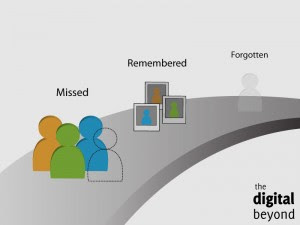
Here's a Web site that has gone so far as to discuss Stages of the Digital Afterlife. It mentions what I talked about earlier: death... remembered... forgotten.
(Here's a great, short little explainer video)
(Here's a great, short little explainer video)
Regarding the Forgotten stage, the site says this:
"As far as I’m aware, there are no services addressing this stage. This is where the real potential exists in this industry. Imagine being able to examine the online content of your ancestors and know who they were and what they thought. I’m not sure how this will work, but we’re here to talk about it."
Sound like it's a conversation pushing itself to the forefront of the cultural conversation.
* For kicks, I Googled "Digital Immortality" and stumbled across this creepy Web site. Despite its "old-school" appearance, it does address questions about the ethics of Digital Immortality (copyright, for example).
Saturday, March 13, 2010
Six Hours Hooked Up to an IV Drip
If being a fledgling reporter is like having the common cold, then I spent a chunk of my morning and afternoon soaking up that which will help me get better.
You've heard it said since you were young: the best treatment for the common cold is a combination of rest, fluids and waiting.
Somewhere in the mix, you heard something about vitamin C and how taking it might prevent - or even cure - your ailment.
However, studies show no real link between the nutrient and even shortening the duration of the common cold, let alone curing it. Read more about that in this Newsweek article.
According to that article, though, doctors don't mind that many people take vitamin C in hopes of improving their health, since "consumption of vitamin C is not considered a public threat. (In fact, some studies have associated vitamin C's antioxidant properties with a decreased incident of some cancers.)"
Plus, when the only real cure is to wait it out, don't you like to think you're doing something to help the process along? Taking vitamin C makes the waiting, resting and hydration a little easier.
So if being a fledgling reporter is like having the common cold and the real cure for that is time - or experience - then taking Vitamin C is like motivation.
Motivation alone won't better your reporting skills - just like vitamin C won't cure your cold - but it will help you through the process of improvement and learning.
Today I was hooked up to an IV drip of pure motivation in the form of Boyd Huppert. He's a reporter for Minnesota's KARE 11 TV and highly decorated, at that. Widely considered one of the nation's finest storytellers in television news, ~80 University of Missouri School of Journalism students sat, entranced, as he imparted his wisdom to us during a seminar. (Get a sample of his writing and delivery tips from these YouTube videos.)

One big lesson I took away was to let viewers discover the layers of a story. You can literally spell out for people what they're seeing on the TV screen or you can let them take in information by hearing and seeing it for themselves. Then your writing is free to be a little more nuanced.
He talked about his twelve tools of good writing techniques, which, used sparingly, can help bring a story to life. Those include using metaphors, alliteration, supposition (supposing that xxx, then yyy... see the opening line of my blog!) and the rule of three.
Motivated by his seminar, I am taking actions to improve my journalistic skills, starting with updating my blog and ending with who-knows-what.
What I do know is that I'll be putting his tips to use in my reporting from now on.
See more of Boyd's work in his series, Land of 10,000 Stories.
Saturday, March 6, 2010
This is my brain, on acid.
Acid does funny things to the mind.

Whenever I'm on a bike ride - no matter how intense or leisurely - the final stretch becomes agonizing. Some of it is fatigue after two hours on the trail, but most of it is my conditioned r
esponse to acid.
Lactic acid, I mean.
My tired quads start burning, and I start wondering silly things like whether I'll even be able to make it home.
It's not like the last mile is more challenging than the rest of my ride. I think just knowing the adventure is almost over
causes me to drag my feet - or wheels. The exhilaration of the ride is coming to a close, and instead of finishing well, I dread ending it.
The same thing's going on with my mind as I round my last collegiate lap. Graduation is in May. Job hunting is even sooner. I see the end of this particular life journey, and instead of pushing triumphantly to the end, I dread the conclusion of this ride.
Lactic acid panic of the brain.
If only I could figure out some way to change my response to lactic acid from dread to a burst of enthusiasm, I'd feel much better about the entire ride.
Who wants to end on a sorry whimper when you can sprint to the finish?
While I work on this problem, I'll continue to use my performance-enhancing drug of choice: black, home-brewed Caribou Blend coffee.
By the way, the title of the post is a nod to this classic 90's anti-drug commercial, starring Minnesotan native Rachael Leigh Cook: http://www.youtube.com/watch?v=kci12O2EI8I
Friday, February 26, 2010
Better Late Than Never: True or False?
I am a senior at Mizzou and JUST viewed my first True/False Film Festival film. A highly-acclaimed and -recognized film festival has sat, literally, blocks from my home for the past three years, and only tonight did I attend. And loved it, I might add.
Thanks to the Missouri School of Journalism, I got two free tickets to a flick. I chose The Invention of Dr. NakaMats because it looked quirky. It was. The director was there, along with one of the film's score composers (the other composer, Mark Mothersbaugh, was unfortunately not present).
See a preview here.
The film reminded me a lot of my own trip to Hong Kong in fall of 2006. We had a media guru/documentary filmmaker with us and met a character much like Dr. NakaMats - loud, slightly out of touch with westernized & youthcentric culture, unapologetic and seemingly unaware. Loveable, in his own way, but also very trying, at times.
So - does the saying "better late than never" apply to the True/False Film Festival? I think my tea bag answers that. According to the tag on the tea bag I opened after returning from the film, "You're never too old to become younger," - Mae West.
Coincidence? False.
Monday, February 22, 2010
In with the new...
"You can't teach an old dog new tricks" is a saying that more-than-slightly reeks of ageism and may lie, unspoken, behind many "lettings go," jobforce-wide.
It might be more correct to say, "You can teach a seasoned dog new tricks, but he might not like 'em -- or at least the initial idea of them."
Part of the work in my capstone class - Media Management - includes tackling case studies, in which I play the role of news director in a specific scenario. I'm currently working on a case study, in which, among other issues, a TV newsroom is facing this nebulous concept called convergence. Veteran reporters are suddenly confronted by tasks they've never had to do before, such as writing their own Web stories and tweeting.
My job, as hypothetical news director, is to smoothly oversee this transition. In order to gain perspective, I spoke with one of the anchors at my station -- KOMU 8 TV -- Jim Riek. Jim has been in the TV industry since 1977 and has seen sweeping changes since he first hopped aboard.
Jim is on Twitter, as are all of KOMU's main news anchors, but he said he wasn't an early adopter. He signed up only after "peer pressure" from some folks in the newsroom. He tweets now - and I enjoy learning all I know about golf from those - but he said he has spoken with other people his age in the business, who expressed some frustration over the changes.
TV news now doesn't look very similar to how it did when Jim first got into it, he said. In the late 1970s, TV stations, newspapers and radio stations were three very distinct newsrooms. Now, as almost every journalists knows firsthand, the lines are much more blurred. In some cases, you can't even tell where one newsroom ends and the other begins, not to mention the addition of all things Web and digital in order to further disseminate content.
The one thing Jim said hasn't changed is the opportunity to meet people you wouldn't otherwise meet and do things you wouldn't otherwise do.
Jim is an incredible asset to KOMU -- not only in the stories he puts out (see my latest favorite, about the remnants of nuclear missile launch sites that still lie all over Missouri!), but also in the mentorship he provides to so many of the students at University of Missouri-owned NBC affiliate KOMU 8, where the newsroom functions as both your typical NBC affiliate newsroom AND as a teaching lab.
But, as Jim mentioned, KOMU is unique for that reason. So what about other career journalists who have been in the business for decades and are now facing a whole new world of Web stories and Facebook?
Harking back to my case study, Jim recommended I - as "news director" - suggest to veteran reporters and anchors to give Twitter and other new media a shot. There's no harm in trying, really, and sometimes the first step is the hardest. As Jim said, he wasn't the first to jump on the Twitter wagon, but now that he has, he likes it.
Although not every seasoned TV journalist has college students to directly mentor, per se, many of them do have institutional knowledge and a finely-tuned ability to tell stories from which younger journalists can learn.
A young pup may come into the newsroom with tech savvy Twitter know-how, but a well-trained canine can help that pup learn to craft the stories that need to be tweeted about in the first place.
In with the new... mentored by the "old." And since experienced dogs can learn new tricks, too, and become quite good at them, then perhaps, in turn, the pup can help pave his mentor's way to the Web.
The Week I Slept on My Floor
What started as a Saturday afternoon of cleaning my room soon became an evening of completely rearranging my space, interrupted by dinner plans and a night out.
I returned home to find I had earlier piled half my earthly belongings on top of my mattress in order to clear the floor and vacuum, so I resolved to roll out the mattress pad and Goodwill sleeping bag and call it a night.

Thus began the saga that will go down in my history as the-night-that-turned-into-the-week-I-slept-on-my-floor.
You know these things life hands you once in awhile -- or, more correctly, that you decide to take on yourself:
Unfinished Projects You Obviously Underestimated, Regarding Simplicity.
UP YOURS, for short.
They're the "good ideas, at the time" that land you, for lack of a metaphor, on the floor -- in a shiny blue sleeping bag from a secondhand store designed for someone six inches shorter than you.
Oh, but doesn't it feel good once you actually complete one of these little projects? When you actually complete one... IF you actually complete one...
Stay tuned for the blog post when that happens. (Hopefully, it will be sooner, rather than later. I miss my mattress.)
Friday, June 26, 2009
Fair, balanced and...boring?
A recent article in Newsweek caught my eye. Probably because its title contains the words rape, kill and sleep around. As Chair of Mizzou's Broadcast Journalism sequence Kent Collins would say, it's "sexy." Not in the literal sense, but in the way it catches a reader's eye.

While the "sex" drew me in, the content hooked me, which I will discuss later. As I read, however, I questioned its fairness and balance in portraying both sides of the discussion.
We humans tend to be voyeurs. We love to watch a good fight from the sidelines. In that sense, it's a lot more exciting to watch the "correct" side pick to shreds the arguments of the "incorrect" side than to observe a civilized debate in which both parties have equal say.
But where lies the fulcrum on the balance beam?
Laws of nature dictate equality must come into play to make something happen: either the amount of force I put in directly corresponds to the amount of work that comes out OR a system is rigged to help lessen the force I have to exert to beget those same results.
Take this clever fellow here. He can either bend over, grasp the boulder and hoist with all his might (chiropractor at the ready) OR he can utilize a lever and fulcrum to decrease his workload while still lifting the boulder.
Stick with me; this DOES relate to journalism, I promise!
When two sides are equally matched - like a seesaw - the fulcrum is in the middle. Balancing is easy. In journalism, it's generally easy enough, for example, to balance Democrats and Republicans, because both sides are long-standing American establishments and have people who will speak on the party's behalf.
What if a journalist is covering a chapter of neo-Nazis and a group of self-proclaimed "peace lovers" who are at odds at a National Socialist Movement rally? Then, perhaps, the metaphor looks a little more like the boulder illustration above - it take a lot more work to make coverage "fair and balanced" since the public at large is already so heavily against the stigma and history of anything that smells of racial supremacy and hatred.
So...who judges what qualifies as "fair and balanced"? As so-called gatekeepers, journalists charge ourselves with presenting germane, intelligent and neutral coverage to equip viewers, listeners and readers with the tools to make their own informed decisions. We are not ushers, guiding people down one aisle or another. Instead, we are park rangers with a working knowledge of several paths, so that when people approach and ask for route information, we can tell them what they may find down each way.
Two examples further my question of where to draw the line and set the fulcrum.
My Experience
I recently reported a story for KOMU-8 TV, in which the city of Columbia and its citizens engaged in dialogue over the plans for an extension of a particular roadway. Members of the team researching the project presented four potential plans to the public, each projecting a slightly different way of extending the road.
The road extension would greatly relieve the traffic that currently greatly burdens one particular road in Columbia. Many on both sides agree it is necessary.
One woman with whom I spoke, however, had an incredibly compelling story. She told me three of the four plans run right through her property. She also said one of the members of the team exploring the expansion told her the fourth plan was the least likely to be picked, so chances are good some or all of her property may be upset once the city obtains funding and builds. This woman's house survived a lightning strike and resultant fire, decades upon decades of Missouri weather and - now - renovations as she turns it into the retirement home of her dreams. She wants to be a lily farmer.
Hers was a story I felt had to be told. But how could I tell it without making the city look like the big bad wolf coming to huff, puff and blow her house in?
I encourage you to watch it for yourself, but what I did was start with her story to humanize the larger issue. Then, I did a stand-up in front of the most congested intersection of the road that needs relief from traffic flow to demonstrate that there is a problem the city is looking to address. I used that to segue into the meeting the city held to discuss options.
I very consciously presented both sides of the issue, and tried to do so fairly.
Journalism Response
By Newsweek Senior Editor Sharon Begley, with Jeneen Interlandi
In this article, Begley describes the conflict between the evolutionary psychology school of thought and the more modern behavioral ecology. The latter is a long-held-by-some belief that our actions today are motivated - directed - by genes that were necessary to reproduce and stay alive back in the caveman days.
Evolutionary psychology, for example, would argue that "rape genes" were beneficial to males, because they assured the fullest spreading of seed - both to willing and unwilling partners. They got passed down and, voila, that's why we still have rape today.
Behavioral ecology, on the other hand, argues that humans didn't evolve in a static environment and that what was beneficial in early days might be detrimental now, so we don't have to "take it with us" regarding behavioral traits.
Reading this article, however, I felt the writer saw evolutionary psychology as disproved and behavior ecology as the answer to it. Both fields have people still pursuing and believing in their methods, so I'm left wondering whether she should have given more credence to the older?
I'm not advocating either way - I'm simply pondering, as a journalist, how much benefit of the doubt we should give to a belief that some see as "on the way out," but that others still follow.
Perhaps "fair and balanced" doesn't always mean an even 50-50 split of coverage. Perhaps it just means giving both sides their say, whatever the capacity, taking into account public opinion. I think most people would not like the media to give 50 percent of coverage to express the view of a protesting hate group.
Thursday, June 18, 2009
When You've Been Around the Block...Longevity in Journalism.
If you gave yourself 15 seconds to list as many journalists as you could, I bet your list would be a split between current national journalists, local journalists you've known over the course of your lifetime and national journalists from the past. My list, for example, would include Anderson Cooper, Boyd Huppert (KARE-11), and Edward R. Murrow, respectively.
These journalists, for various reasons, have burned themselves into our brains. One name, in particular, I'd like to discuss now, and that's native-Missourian Walter Cronkite. Twitter informs me the news legend is rumored to be near death. I saw two articles posted about this:
Still, neither these nor the countless other returns I get when I Google "cronkite near death" are from national news sources, and so I remain skeptical.
However, my point about Cronkite is not focused on his potential passing, significant though that would be were it, indeed, true. Rather, in the article on gawker.com is a link to the broadcast where Cronkite announces Kennedy's death. What a stunning example of going live without all the details!
Also, if Cronkite is on one end of the journalism longevity spectrum and I am on the other, I'd like to share an experience I had as I took a step toward those of Cronkite's ilk.
Journalism Response
CBS news, November 1963
Before I launch into an analysis, here is the video I am referencing. I will point out specific moments afterward, but take note of how personal he is. Though the situation is intense, I feel he is speaking just to me. He's not married to his sheets of information - clearly on the desk to his right - nor is he a rote fact-machine. He tells a story...as it's unfolding...in all its significance.
He spends the first 30 seconds telling viewers exactly what happened and updating them with all the things CBS knows: both confirmed and unknown. Cronkite speaks carefully and deliberately about what is still unconfirmed.
Cronkite then tosses to the local reporter in Dallas, who fills viewers in on what's happening on the scene, though he seems a little more quick to broadcast rumors, such as the president having died. Though we know in retrospect he was technically correct, the word was not confirmed when he spoke it.
At 1:37, we see Cronkite pause to listen to a report coming into the newsroom. Cronkite then shares with the viewers it was a report they'd already heard. I felt instantly more drawn in to Cronkite because he included me in the breaking news and explained to me what had just taken place where he was.
The toss back to the seemingly-ongoing feed in Dallas acts as a safety net - for Cronkite, himself, to intercept the latest news (and possibly grab a glass of water) while the minute-or-so of the local reporter comes through.
Up until the very end, Cronkite keeps filling viewers in with little details about the day and repeating what's already known and yet unknown. For the time he has to fill, it comes across as surprisingly direct and not circular (saying the exact same things over and over again as a "filler").
From 5:00 on, Cronkite deals with his own emotions and the responsibility of informing a nation of its loss. I can't exactly tell whether Cronkite is choked up or simply in disbelief, but the official news that the president died clearly knocked him off his "game" for a moment. I think he maintained incredible professionalism, pulled viewers in by showing his human side and didn't exhibit any kind of "bias" by becoming overwhelmed by the death of the president. The president is the president, and the national implications of an assassination are significant.
I take away from this video the professional and in-control demeanor Cronkite maintained throughout the entire thing and how he made the breaking news feel like a conversation, though a very serious one.
My Experience
Despite having not even two years of Columbia living under my belt, my work as a journalist - both on the student level and as one at KBIA or KOMU-8 TV - has taught me much about the area.
This morning in my Broadcast II course, professor Greeley Kyle gave us a quiz on mid-Missouri geography. Without having formally studied, I knew the vast majority of the quiz, including the location of five mid-Missouri cities and the major roads that run through our viewing area. This is because I've covered enough stories in enough places and traveled around so that I know the basic lay-out.
Even more rewarding was my coverage of the most recent Columbia city council meeting. I walked in a realized I could name and recognize several community members - not just those serving on the council, but members of the audience, as well. In fact, one particular gentleman whom I had interviewed for a previous story I approached for this story as well, since I knew he was an expert on the topic I was covering.
I like recognizing community members due to journalism work. It drives home the fact that I'm reporting the news for these people in this community. The more I stick with this business, the more familiar I'll get with wherever I end up - and whoever's there.
I can only imagine how many people Walter Cronkite knows.
Friday, June 12, 2009
The Race for Equal Coverage
Sometimes colorblindness is just blindness.
Many classes I have taken - both as a Missouri School of Journalism student and as one getting her minor is sociology - have opened my eyes to the issue of colorblindness. Culturally, society differentiates between skin color: both in bad ways such as racism and in good ways such as the celebration of the diverse and unique cultures that comprise the flavor of a nation.
If people - viewers - differentiate between race, our newscasts should not be totally colorblind. Responsible reporting of race is required in any newsroom, of course, and, gone about in the right way, it can bring education and awareness of important cultural, social, ethnic and racial issues into peoples' homes.
Two recent issues have brought race into my mind for this blog entry. First, I fielded a call from a viewer who had a strong opinion about a particular instance of race omission in a KOMU-8 TV newscast. Second, an editorial report about the "racial wealth gap" on CNN.com got me thinking about the "fault lines" we discussed in my Cross-Cultural Journalism class.
My Experience
I received an angry call from a viewer the other night while working the assignment desk and tending to KOMU.com.A woman phoned in after KOMU-8 TV ran in our 6 p.m. newscast a story about a man who robbed a local store. Here's the description we gave:
50-year-old male
Height: 5'7"
Weight: 160 pounds
Wearing a short-sleeved shirt, jeans and cap
The police report, however, also listed his race. The viewer who called in said we should have reported his race because there were enough other descriptors to give an accurate portrayal of what the man looks like - enough to possibly lead to his arrest.
And she was right.
KOMU-8 TV has been discussing with its employees its policy about reporting a suspect's race lately - so much so that it was the topic of this week's Your View segment, in which anchor Sarah Hill discusses one or several viewers' comments. See that report here.
While the suspect's race did not make the newscast, it did make the web story, as the person working on KOMU.com at the time we received the press release decided the description was detailed enough to merit the inclusion of race.
This whole ordeal speaks to the need for not only attention to detail in police reports and asking what description will best equip viewers to be on the lookout for this person, but also communication between all jobs in the newsroom. Had the dotcom editor and 6 p.m. newscast producer spoken, perhaps this could have been avoided.
For the sake of transparency and accuracy, having several pairs of eyes look over anything that's going on air is required, though sometimes the race toward a 5, 6, or 10 p.m. deadline limits that.
Journalism Response
By Thomas Shapiro*
*Thomas Shapiro is director of the Institute on Assets and Social Policy, Pokross Professor of Law and Social Policy at Brandeis University's Heller School for Social Policy and Management and author of The Hidden Cost of Being African American: How Wealth Perpetuates Inequality.
Shapiro opens his article by writing, "Closing the racial wealth gap needs to be at the forefront of efforts to achieve economic opportunity in the 21st century." With that, he launches into an explanation of the accumulation of wealth - or deprivation.
Caucasians, particularly white men, who started off as the ones in power back in America's foundational days, passed that status down from generation to generation. While the Civil Rights Movement, awareness and overall education of people have helped lessen that "power gap" over the centuries, a gap nonetheless remains - not only socially, but also financially.
The appreciation of a house's value, much like a stand-up or live shot in a TV news story, is, as Shapiro writes, all about "location, location, location." Although, whereas a reporter is looking for a visually-interesting background, Shapiro is referring to the "racial and ethnic makeup of the community."
This strikes me in regards to Columbia, Missouri.
A quick background, as I understand it: Legend has it we are the Mizzou Tigers because, during the Civil War, the Yankee men "fought like Tigers" to keep the Confederate line from advancing to Columbia. How much truth there is to that, I don't know. However, it's the legend that is important here, because despite commemorating the staving off of the south and all the segregation it embodied, Columbia still appears partitioned.
"Mid-town," as I like to say, is "Collegeville": Mizzou, Stephens College, Columbia College, etc. The south side feels a bit like the Minnesotan suburbs, where I grew up. The north side is noticeably more populated by people of a lower socio-economic status and/or of minority groups than the other parts of Columbia.
The metaphorical "fault lines" of race and socio-economic status are literal here, and the questions I have are how and whether to address it. Is doing a story on an African American heritage festival in town enough, or should I be addressing the issue Shapiro brings up in his article?
Shapiro's writes, "The racial wealth inequality is the hidden fault line of American democracy. We need a new civil rights movement for the 21st century that focuses on economic opportunity and inclusion and closing the racial wealth gap."
This article is a good example of raising awareness through journalism without bias. Shapiro, CNN.com points out, wrote this article "Special to CNN," but is not a staff writer.
This is a huge topic - bigger than I can even begin to cover in a single blog entry. However, know that it's on my mind - both in regards to news coverage and how I go about the city in which I live.
On a final note, I encourage you to read Shapiro's article, as it provides some really interesting food for thought and hard-number examples of the wealth disparity between African Americans and Caucasians - particularly in this economic climate.
Friday, June 5, 2009
Liking People isn't Enough
"I just love people's stories and sharing them with others." That's the response I usually give when asked why I'm pursuing journalism.
Fluffy, I know, but it's easier than launching into a long-winded explanation about how journalism as the fourth estate and journalists as gate-keepers fascinate me, how deadlines thrill me and that uncovering what perhaps most people don't know and shedding light on it - and having an outlet to share that information - is a privilege I seek and relish.
As the professor of my Broadcast II course Greeley Kyle said in class the other day, many people ask "How are you?" without really wanting or expecting a substantial answer. I think we become culturally attuned to this as we grow and therefore get used to giving short, sweet and simple responses. (i.e. You'd better have a real compelling reason for answering small-talk questions in more than two sentences.)
My blog entry this week addresses both of the above, related topics. I'll describe an interview I had with a source last Saturday that went far beyond, "How are you?", as well as a panel of seasoned journalists' take on why young journalists should stick with the job in the current state of the economy and business...that "really liking people" isn't enough.
Journalism Response
Panelists: University of Missouri School of Journalism Professors Lee Wilkins, Charles Davis and Lynda Kraxberger
Station: KBIA Radio
Listening to Wednesday's Views of the News on mid-Missouri's NPR affiliate KBIA, head of the MU convergence journalism program Lynda Kraxberger described the advice she has been giving to the spring 2009 MU School of Journalism graduates, who are facing, as Kraxberger said, "the worst time for someone with a journalism degree to be looking for a job."
"We have had many heart-to-heart discussions with our students about: keep doing what you love, even if it has to be journalism as a hobby. Keep your finger in it, your hands in it. Keep doing things that will allow you to get better at what you do while you do the things that are necessary for you to make a living, and five years from now, people are not going to say, 'Well, why did you do that as a career move?' Everybody will say, 'Oh, well, that was back in 2009, and everybody was doing what they had to, to survive back then.'
"And I really do think we’re going to come back and look at that. Yes, those were very hard times, but it separated out the people who are very passionate about reporting and journalism as a public service from people who are, 'Oh, I thought it would be fun because I could travel around the world,' or, 'I could talk – I like people.'
"Journalism really isn’t about liking people. Journalism is about really wanting to know information and being fair and getting information to people before they get it from anywhere else."
(21:45-23:42 of downloadable .mp3)
Kraxberger's words struck me. I used to inwardly doubt fellow journalism students of mine who kept a blog or photo bucket with any amount of seriousness beyond doing it for fun.
"What's the point? How many people can actually be reading or viewing this?" I thought.
Well, Kraxberger's words say it all. A true journalist will not be kept from doing what she or he loves, regardless of how official or wide-read/-viewed the work. At this point in the state of our nation and profession, blogging about journalism, movie reviews, or photo shoots may be all an aspiring journalist can manage to do while making a living in a different sector of the workforce.
I have sometimes measured the amount of effort I put into a piece of work based on who will see it: the importance &/or number of people. I don't think this is entirely unreasonable. If I'm going to put hours of work into uncovering an untold and important story that could change the way people see or do something, only to have it viewed by ten people, then the full potential of the story has not been realized.
However, perhaps I require a slight shift in - or addition to - my journalistic motivation. My work is not only to better and inform the world around me, but also to better and inform myself. If I put hours of work into a project and it's only seen by a few people...haven't I still gained and grown from the process?
This segues well into an experience I had last Saturday, in which a beautiful story remains untold...and I am determined to one day tell it.
My Experience
I reported a story on KOMU-8 TV last week about a new soybean plant in Moberly, Missouri and what that means for the farming and biodiesel fuel industries.
I toured the plant, got information from a couple of sources and then determined that I needed to hear from a soybean farmer not connected to the plant in any official way. I wanted to talk with somebody who might be affected by the plant's opening.
I put my iPhone to use and Google searched for a nearby soybean farmer.
SIDE NOTE: Thanks to my Solving Practical Problems in Journalism course this spring with journalism professor Clyde Bentley, in which we explored the future use of cell phones in journalism (see the final video findings my group and I produced), I make an ambitious endeavor to use my iPhone in the reporting process, and it has served me extremely well.
I located an address that happened to be 2.2 miles from where I was sitting, Googling, so I drove there. The woman at the house told me she and her husband no longer farm soybeans but directed me to another man who could talk about it.
I followed her detailed directions - look for the first two-story house about four miles past the funeral home - and ended up on the property of the first man seen in my story.
Although the man no longer farms soybeans, he had farmed them for more than fifty years and had been the Randolph county commissioner for fourteen years. This guy knows soybeans and the local economy. I asked his opinion and got good information for the story.
However, much as professor Kyle spoke about in his lecture on interviewing, I dug deeper and fully gave myself to this source and his late-teens/early-twenty-something-year-old grandson, who was out with his grandpa when I pulled up to the house. Because of that, I discovered a story that touched me and I think is worth telling to a larger audience.
When informed that he no longer farms soybeans, I asked why not. He told me his wife died eight months ago - to the day - and after that he felt lost. He lives in the more-than-125-year-old farm house that has been in his wife's family for four or five generations. He told me his wife was born and died in the exact same room. Now, much of the man's family lives on the property, their houses either just across the street or field.
He and his grandson spoke about the recently-departed matriarch with a candid genuineness I don't often see in people. They asked whether I wanted a tour of the old farmhouse. Ahead of schedule, I said yes. Besides, perhaps it was more than coincidence that I rumbled up their dusty dirt road in the KOMU station vehicle on such an eight-month marker. If I could learn something more about this touching story while honoring this woman's memory, then I would.
The interior of the house dripped with memories. The men told me stories in each room - mostly about the wife and grandmother and her positive impact on the family.
I won't go into further detail, but I learned enough from that tour and conversation to decide I want to take this story further, either by passing it on to KOMU-8 TV anchor Sarah Hill, who has a feature series called Sarah's Stories, or pursuing it on my own time.
If that unfolds, I will blog about it. Until then, the story remains alive in my mind, ripe for the telling and further exploration.
Thursday, May 28, 2009
Musings o'er the Motherland
I love Missouri. It's a great place, and I'm happy to being attending school here. However, my desire is to one day head back to Minnesota, where I grew up, to do good journalism. Therefore, I always have an eye and ear on what's going on back at home. How entirely appropriate, then, to launch my B2 blog with a reflection on a Boyd Huppert piece that ran a couple of weeks ago.
Journalism Response
Journalist: Boyd Huppert
Great lead - "The most unlikely bartender in the state of Minnesota may well be the 76-year-old Pakistani immigrant pouring beers on Friday evenings in the tasting room at the Surly Brewery in Brooklyn Center." - it grabs me and elicits a, "What is this, now? I'm intrigued and must read more." Sets the scene. Establishes the CCC immediately.
No matter how alcohol dresses itself up, it always seems shrouded in some degree of stigma in culture at large. However, this story is not so much about a successful beer brewery as it is about a family united around a successful business...which happens to be alcohol. I think this came across well, especially with the statement from Omar's wife Rebecca, "It's all the same thing, but we just changed what we were selling" in regards to the switch from the owner's father's original abrasives company to the brewery it now is.
I like how this story answered every question as it popped to my mind. They mentioned "Surly." I asked myself, "Why would they name it Surly?" A sentence later I read, "The name Surly was chosen to represent the way one feels when they can't find a good beer."
One question that did pop to mind on a larger scale is the growing popularity of beer breweries and microbreweries. What's the difference between the two?....I just consulted my dashboard dictionary widget, which told me a microbrewery - as I suspected - produces on a smaller, more limited scale. Often only local.
I'm interested that there's no "posted by" credit near Boyd Huppert's name at the end of the story. Do you think he posts his own work, or is the webmaster a more invisible job at KARE11 than at KOMU-8? And if only one journalist's name is on a story, she or he puts her name out to take any and all feedback - good or bad: from the great, readable format to the grammatical error in the line, "...while Nick get's to come along for the ride," to be nit-picky.
And they only had one related web extra (besides an image and the story video): a link to the brewery's homepage.
My Experience
I got chewed out yesterday, and rightfully so...I think.
I have a bit of a problem (some wouldn't call it that) of unquestioningly accepting the authority of adults - especially those who demand respect through a confident demeanor. Well, as KOMU-8 TV news director and RTNDA chairperson Stacey Woelfel pointed out in a recent blog, my fellow "Millennial" generation-types and I don't know how to question authority.
With that said, I tried contacting a source on my cell phone for a quick comment about her organic food consumption habits. This woman mentioned she used to work for a particular newspaper and, although extremely busy, sounded willing to help me. When she asked about my deadline, I told her it was that afternoon, knowing I only had the broadcast lab camera for several more hours, even though the story was technically due the next day. And, honestly, I had really just called her on an whim.
Her tone immediately shifted to one of curt annoyance.
"You're calling me now for an afternoon deadline?" she said, nearly-incredulously.
Caught off guard, I stammered some words about also wanting her opinion and not necessarily needing an in-person interview. She, (graciously, I think), gave me the names of several people I could contact or places I could look to for more information, but ended that list with, "And just for the future, it's respectful to give a person three or four days' warning before doing an interview. Good luck."
On a side note, her interview, which I clearly did not get, was by no means integral to my story, but it would have added more depth.
Into my thoroughly-shamed, scolded and sheepish mind wandered the question, "But what about day-turns?" Yeah, that'd be GREAT to give three-to-four days of advanced warning to sources, but most news is no longer news by the ten o'clock newscast, let alone several days later!
Anyway, I don't know to what degree - if any - I am at fault here. Still, the sting of humility doesn't quickly recede, nor will the lesson this experience imparted...though exactly what I should take away from it I'm still deciding.
Subscribe to:
Posts (Atom)


